We’re back with another tune from our Messin’ With The Music series. Instant Karma! (the exclamation point is officially part of the title) was released by John Lennon in 1970. This song came out at the same time The Beatles were working on Let It Be. One interesting fact about the song is that it was written, recorded and released within a period of ten days. That’s an incredibly quick turnaround, especially for an artist at that level of success. It’s always been my favorite Lennon solo single. The idea that karma, ‘you reap what you sow’, could happen instantaneously rather play out over the remaining course of your life is a very appealing idea. The power in Lennon’s vocal always felt like a big middle finger to every self centered person who screwed other people over. Karma, of course, works in both directions. I also find the idea that people who do good will receive good in return appealing. Personally I wouldn’t mind seeing instant karma doled out for much of what happened in 2020 (and continues to happen in 2021).
We kept with our usual Messin’ recording protocol using single mic straight through tracking. We did put in a pretty full roster of tracks for this song. The original was Phil Spector produced and used multiple piano takes for it’s basic feel. Spector was famous for his ‘wall of sound’ methodology and it shows in this recording. The original was also swimming in reverb to make it sound even bigger. For our base tracks we used finger picked acoustic guitars and recorded two separate tracks, panned hard left and right. There are two separate mandolin tracks, one using mostly chords and the other generally picking single notes. A third mandolin part plays a little riff in the instrumental break. We added a bass guitar track and a sparse single note oriented banjo track. Percussion tracks include tambourine, shaker, washboard and wood block. There’s a main vocal track with a harmony vocal floating underneath in the verses. We wanted a bigger sound in the chorus in keeping with the feel of the original so we have a main vocal and four other vocal tracks that are panned in hard stereo to give that bigger feel.
I really enjoyed finally being able to do a cover of this song. We hope you enjoy it too.
Electrostatic Rhythm Pigs play John Lennon’s ‘Instant Karma!’:
It’s been a while since we checked in to see what’s happening with one of our favorites, Reverend Peyton’s Big Damn Band. The band has always put out stellar work whether it’s audio, video or live music. I’m including two videos that will give you an example of all three areas. We’ll start with the recent video for ‘Too Cool To Dance’. As always, the playing is great. Rev’s still finger picking the hell out of his guitar. The recording sound is a bit cleaner and smoother than some of his early work, but just as fierce. And the video maintains the great humor of his other videos. The band’s vibe remains ‘let’s have fun and not take ourselves too seriously’. They always bring the same joy to their live shows.
The next video is from a recording of the Elmore James classic ‘Shake Your Money Maker’. The band recorded this live in Sun Studios with Dom Flemons, the legendary Steve Cropper and bassist Scot Sutherland. So many cool things going on. The video was made on an iPhone and synced with the live recording. Check out the classic equipment used in the recording. We recently talked about live studio recording in a post. This video is an amazing example of nailing a take. I’m not going to over analyze. Just sit back and enjoy it!
Amazing. We’re almost in to the second half of the year. 2020 dragged on like watching an endless horror flick during a long drinking bender. I had high hopes that 2021 would end up being the great release and return to total normality. Silly me. Yes, things have gotten better. But this year still feels like a bad hangover from last year in many ways. I don’t think any of us wanted to give up another year just trying to return to ‘normal’. But anything that is worthwhile takes some work. So I’m trying to work on the good old ‘positive attitude’ and just ‘keep on truckin’ as the old hippie saying goes. Let’s take a deep breath, sit back, and listen to some tunes and see what we can come up with for positive attitude. We just finished re-watching Ken Burns’ great ‘Country Music’ documentary. Every time I watch it I pick up some new inspiration and ideas for songs. Hearing how great songs were conceived and constructed really helps to fire up the old brain synapses. And the wonderful simplicity of early country songs shows what’s really important when you’re writing. They often referred to country music as “three chords and a great story”. With the best songs the human connection always overwhelms any ‘simplicity’.
First Up: Bluegrass Jam – ‘Where The Wild River Rolls’
Let’s start with Bluegrass Jam. First, since we were talking about country and bluegrass music this is a great example. I really like the video because it gives you a great picture of live recording technique. In the studio, I would always give musicians who wanted to record ‘live’ the pros and cons. And truthfully, recording individual parts as overdubs is what I would usually recommend. One of the main reasons is that if one person makes a mistake like an incorrect chord change, in a live setting the entire group will have to re-record the track. Not all situations lend themselves to live recording. If you’re playing through amps with a live drum kit, the bleed through in to microphones can cause some tracks to overwhelm other tracks. The bluegrass instrumental set up we see in this video lends itself much better to a live recording. To do this you have to learn some ‘mic technique’. You’ll see someone step up towards the mic during a solo or back away when necessary. You also have to be aware of how hard you’re playing to keep a good mix and bring different instruments to the front of the sound at different times. Distance is important – each instrument projects sound differently. Banjos really project so you’ll stand a little further away. The three mic setup is nice – real old school recording had everyone work around one mic. Finally, I like the song a lot, it has a wonderful feel; the players all do a great job on their instruments and the idea of getting a recording like this live in a living room is totally awesome.
Next Up: Jane Weaver – ‘The Revolution Of Super Visions’
For our second tune this month we’ll move along to the wonderful world of thumping bass and snappy drums that highlight Jane Weaver’s ‘The Revolution Of Super Visions’. One of the basic needs of a great funk song is a stellar drum track. It doesn’t have to be complex – in some ways complex would totally defeat the purpose. The drums are placed relatively high in the mix, and rely on the snare, high hat and kick to keep the beat going. Although the beat sounds simple, getting that groovy hi hat is not as simple as it sounds. Sometimes for drums keeping that slinky sound is much more difficult than blasting all over the kit. The verses keep the music a little more minimalist. There’s a clean guitar playing little riffs at the high end of the scale, a pretty standard feel for a funk based tune. You need that sound to cut through because a lot of funk has a heavy bass bottom end. In this song the bass is joined by buzzy synth sounds that act as a second bass feel. Weaver keeps her vocals high and airy, floating on top of the music. I like the fact that you can easily pick up the lyrics as the song is delivering a story and a message. When we hit the chorus the music fills in. Several more keyboards are added so the chorus really hits home. You need changes in dynamics to keep a dance song interesting and that is often created by beefing up the amount of instrumentation or vocals in the choruses. The little touches in the song that you may not notice if you don’t listen carefully also make a difference. Listen for the background vocals during the verses echoing the main vocal as well as more short riffs by bass and synth. Turn it on up and dance!
Finally: Alabama Slim – ‘Freddie’s Voodoo Boogie’
For our final track let’s venture in to a dark, smoky lounge and feel some old time blues boogie. Alabama Slim has been working the blues for quite a while. At 82 he’s still dropping great blues albums. He just put out a new album, The Parlor, in 2021. I decided to grab this song for the great ‘boogie blues’ feel it has. This blues style has been around quite a while and many great rock bands have taken this style and ran with it over the years (think early ZZ Top, ‘La Grange’ era). In this type of song the guitar is king. It’s backed by real simple percussion. The vocals are spoken as much as sung. A key to playing this on guitar is that it leans on the rhythm you do with your right hand as much as the melodic notes you’ll hit with your left hand (yes, yes, reverse that if you’re a left handed guitar player). You can pick up little riffs that repeat throughout the song. Pinpoint accuracy on notes is not real important. It’s all about the feel. He probably doesn’t play this song exactly the same each time he plays it. For me, that’s just another point that makes it fun and interesting. Turn it up, stomp your feet and feel it in your bones.
Retro: James Gang – ‘Funk #49’
What song to pick for the monthly ‘retro’ selection comes to me in many different ways. Sometimes I try to pick something a little more obscure that I think should of been more well known. Sometimes I cruise through my album collection and think wow, haven’t heard this in a while. Sometimes when I’m picking the new songs they trigger ideas of older songs. When I was listening to Alabama Slim, I thought, hey, haven’t heard ‘Funk #49’ in a while. A lot of people are familiar with Joe Walsh through hearing his solo work or work with the Eagles. I first heard him playing with the James Gang. ‘Funk #49’ is such a fun guitar song. The song’s initial guitar riff alone is worth a listen. Great string bends and a sloppy little riff start the tune with rest of the band dropping in perfectly. It also has one of the coolest middle breaks you’ll ever hear. The song is first stripped down to just drums and vocal shouts and hoots. Then that great, bendy initial riff hits again before the entire band comes back in. Absolute classic.
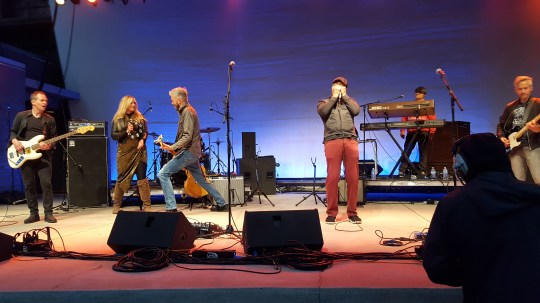
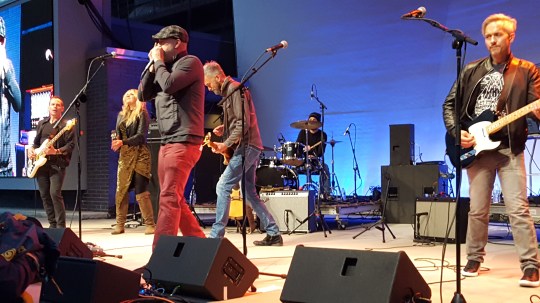
I finally got to see a live band last Saturday night. We went with friends to see The Verve Pipe at Levitt Pavilion which is a local outdoor venue. It was the first time I’ve been to see a live band in over a year. It’s been so long I almost forgot how much fun it is and how much seeing live music adds to your life and elevates your attitude and sense of happiness. It was one of the coldest May 29ths on record around here and we were in a misty drizzle. Shows are still social distancing so it wasn’t very crowded (OK – I sorta like that part). None of the conditions affected how great it was to see a show. It felt like a return to real life.
The sound, performance and music were awesome. The band put on a great show. Kudos to the band for going all out – it’s got to be a bit more difficult playing to a smaller crowd on a cold, wet evening. They even added some cool cover songs to their set. Highly recommend seeing The Verve Pipe if you have a chance.
I’m really hoping our return to some form of normality (at least as far as live music goes) continues. You sometimes forgot how much connecting with a band and their music in a live setting adds to your life. It can lift you up and pull you through a full range of emotions. I know it does the same for a band when you play a live show. We’ve been in a period of darkness. Let’s all cross our fingers that we’re finally heading back to the light.
In a previous post about change and growth of a band we discussed the career of Talking Heads. I thought it would be interesting to look at another example of someone who has exhibited a great deal of change during their career. This time we’re going to go through some of the music of Beck. There is one big difference between those artists right from the beginning. That difference is working in a band with other musicians versus working as a solo artist. Beck, as a solo artist, worked with whoever he felt like collaborating with from album to album, even song to song. There’s a lot of freedom in working that way. First, you are really the final (maybe only) person who decides what your songs will sound like. Second, without the necessity of working in a band where you’re trying to keep everyone engaged and happy you can pretty much record any style you want. You are also able to bring in musicians who have a vast array of influences and abilities. The ‘down side’, if you want to call it that, is that all the work and creative idea construction falls solely on you. You can pick ideas from a variety of collaborators, but in the end, it’s your name and reputation on the line every time you put out music. You definitely have to have a strong sense of self to work in this fashion.
Beck had been performing as a solo artist beginning in his teenage years. In some ways he lived the life of a busker, travelling between the coasts and becoming involved in various folk and conceptual art scenes that interested him. His performances could be ‘eventful’ as he would make up songs on the spot if the audience wasn’t paying attention. Or wear strange costumes and set his guitar on fire. Again, being a solo artist allows you to take any chance you want. You’re not affecting the careers or lives of the other musicians who may also be close friends.
Although he released and handed out cassettes of his music (later made in to albums after he became successful) ‘Loser’ was the flash point that began his career in earnest. An amazing aggregation of folk, hip hop and everything in between it was not expected to be a hit, but the public really makes this decision for you. Add in a crazy, cut and paste video and the world was introduced to Beck. I’m not sure how many people haven’t seen this video, but the freewheeling joy of it amazes me to this day. In the long run, it became the anchor of his first album, ‘Mellow Gold’. In case you’re wondering about the first line of the chorus, ‘Soy un perdedor’ literally means ‘I’m a Loser’ in Spanish.
Beck did release another album called ‘One Foot In The Grave’ before his next major album, ‘Odelay’. ‘Odelay’ sits in my album collection as one of my favorite albums of all time. It had several ‘hit’ songs, but the album sticks with me as I always listen to it front to back, there’s not a song that I would think of skipping through. Musically, what category does it really fit in to? I’m picking ‘Devil’s Haircut’ as the song from this album. There’s great sounding drums, a bass part that has a riff that holds everything together and sits as the main theme that the other music works around or copies. A lot of the rest is studio sampling magic. It almost sounds as if random sounds are thrown in. But they’re not random. Try it some time – fitting in the right sound at the right time is an art. Then there’s the lyrics, strange phrases that act as images floating in your head. Do they have an overall meaning? Maybe – whatever you want.
After the studio production heavy ‘Odelay’, Beck put out a quick album titled ‘Mutations’. It was meant to be the opposite of the production style of ‘Odelay’, more live recording of the players. This was not an album that ever became a big public recording. I think that this again is a benefit of being solo versus being in a band. When you take chances it’s all on you, you don’t have to worry about how decisions could affect the other band members. The song ‘Cold Brains’ feels like psychedelic folk, much more like a full formal band.
After ‘Mutations’, Beck released ‘Midnite Vultures’. In some ways this returns to the studio production feel of ‘Odelay’ except I always felt there was a whole lot more funk going on. The song I’m choosing from this album is ‘Peaches And Cream’. It always reminds me of a somewhat warped mirror version of a Prince song, right down to the falsetto delivery of the vocals. Just when you think you can grab on to it as a straight forward funk song, there’s a noise guitar or odd keyboard/sound sample to throw a monkey wrench in to the flow. Even though it feels like a trip back towards ‘Odelay’, it still takes a lot of steps in to new territory throughout the album.
‘Midnite Vultures’ was followed by a very different style of music on the album ‘Sea Change’. The tracks are anchored by acoustic guitar and relatively straight forward lyrics. For an artist who had attained his level of success, this could be a big risk. Beck had built a brand on strange, funky studio experiments. Breaking this down to acoustic songs with more personal lyrics was a risk. ‘Lost Cause’ is acoustic guitar, simple hi hat drums and some string sounds in the background. It definitely centers on the vocals and lyrics. Where most of his previous work had been upbeat and odd, ‘Lost Cause’ and the other songs on ‘Sea Change’ had that feeling of sadness and melancholy. This type of change is where you find the true genius of the best artists as Beck pulled off this change and still delivered songs that could touch people emotionally.
Beck’s next album, ‘Guero’, returned to the style exhibited on ‘Odelay’. There’s a lot of studio production work and sampling. He also worked with a variety of producers when putting the album together. Our selection for this album ‘E-Pro’ has a lot of parts that grab me. It certainly indulges my love of cracking, fuzzed out guitar. The drum beat drives everything as you never feel a let down when the song moves just to the drum beat and vocals. Again, if you listen to all the parts it seems like it would be simple to put a song like this together especially where there’s just drums and vocals. One sign of genius to me is taking something that’s actually pretty difficult and making it look simple. I also really like the video for the song. The movement between animation and reality is in constant motion, just like the song.
The next album was titled ‘The Information’. The song I picked from this album is titled ‘Think I’m In Love’. To me it sounds like a more straight forward indie rock style song. As always, you can certainly tell it’s Beck by the little flourishes that are thrown in throughout the song as well as his distinctive vocals. One thing I’ve always liked in Beck’s music is his elevation of bass in his songs to where it is often the big rhythmic and/or melodic hook. There’s a really nice break in the middle of the song which adds acoustic guitars as well as keyboards/strings. He combines many things he does well here, keeping a danceable beat moving along with vocals that act as another rhythm part. At this point in his career he had a large library of prior styles and ideas to choose from.
On the album ‘Modern Guilt’, Beck continued to mine the vast array of different styles he had previously used. ‘Chemtrails’ fits in to the neo-psychedelia mold. As I’ve gone through his albums for this post I’m amazed at the variety of styles that I usually touch in the Grapevine series that he hits in his albums. All of his music, while having one foot in a variety of styles depending on the song tend to keep a piece of his own unique vision in them as well. One of ‘Chemtrails’ stand outs is the great live drums in the song. It also feels like the recording is a full band playing live.
For the album ‘Morning Phase’ we return to more acoustic, introspective song writing. ‘Blue Moon’ has acoustic guitar and piano built in to a more standard song style. Lots of reverb on the vocals and really nice backing vocals fill in much of the space. With an amazing encyclopedia of styles and songs at his fingertips, Beck continues to try any type of music that suits his fancy at the time. It’s really unusual for any artist to be able to put out music that fits his current mood and still remain successful both commercially and artistically. He’s released two albums since ‘Morning Phase’, ‘Colors’ and ‘Hyperspace’. For all his success, I think he’s still underappreciated for the wide range of remarkable material he’s released from ‘Loser’ in 1994 to the present day. That’s a long time to be able to continually change, experiment and grow as an artist. Hopefully He’ll continue for many more years.


 ChurchHouse Productions Blog