September 2021 Grapevine

I’ve always liked the month of September. We’re heading in to fall which is probably my favorite season. It’s also when my wife and I often take our travel vacations. We’ll usually be heading to some National Parks for hiking and photography. That’s where we’ll be while you’re reading this. I can’t tell you how renewing it is to get out on a trail and see some of the most amazing sights you can imagine. And after the last two years we can definitely use the life affirming renewal that only nature can give you. The best music can give me the same type of feeling. If you can make a connection with the music you are listening to it can release all types of emotions. It can be fulfilling, cathartic or just make you feel relaxed and happy. This is why I continue to seek out new music rather than staying static and just listening to the music I grew up with when I was younger. My purpose in presenting the Grapevine is to share new music I’ve come across (as well as some older gems) with other people in the hope that you’ll hear a song that touches something inside you. In that spirit let’s get to this month’s songs.

First Up: Swim School – ‘Let Me Inside Your Head’

This song is from Swim School’s first EP ‘Making Sense Of It All’. One reason I wanted to get it out to other people is the band is new on the scene and this album is self released. I love the DIY spirit of any band that takes matters in to their own hands and is bold enough to do it own their own without the influence and push of a record label. The song has the feeling of shoegaze while still putting the vocals out front so you can pick up on the lyrics. On cool trick they do is in the recording of the drums. The first part of the song has the drums more in the background and recorded with some buzzy distortion. At the 57 second mark there’s a short break beat and the drums come back crisper and more up front in the mix. They do another sonic change up with the vocals. In the beginning of the song they are sung softer with an intimate up front feel. At about 1:45 we get another break beat and the vocals become much more forceful with more reverb added. At 2:35 they make another change and drop out most everything but vocals before building up to the end to the song. These little changes keeps the sound fresh rather than having full on drone through the whole thing. You can also pick up all the instruments as separate pieces through out the song. Great recording technique and song structure for a new band.

Next Up: Gruff Rhys – ‘Hiking In Lightning’

First, the hiking title alone fits my September. The first lyric line is ‘hiking In lightning is exhilarating and frightening’. We once got caught in a thunderstorm hiking in Yellowstone National Park. Being out alone on a trail when the storm hit was quite a rush, though most experiences like that are cooler in hindsight. At the time you’re just saying ‘S#&%!’. Back to the song – I really like the drum sound, especially the snare. When I record a snare drum I usually put a mic on both the top and bottom of the snare (we did an In The Studio post on this once). The bottom mic really picks up the rattling sound of the snares themselves which I hear in this song. The snare here stays as a constant driving force throughout the majority of the song. There is a fuzzy drone guitar that fills in a lot of space. It also matches the melodic line of the vocal. Every once in a while the bass puts a note or two up front. There’s an instrumental drop out in the chorus which adds a second voice to enlarge the vocal sound. They finally break up the forward drive towards the end of the song with the drums being allowed to do a much more complicated pattern to close out the song. It’s a good combination of forward driving music with laid back style vocals. Great tune.

Finally: Tom Morello And Serj Tankian – ‘Natural’s Not In It’

This is a cover of a song by Gang Of Four. It’s from an album of covers that marked the 40th anniversary of Gang Of Four’s album Entertainment! which came out in 1979. Gang Of Four is one of my favorite bands, especially from that era of music. The music was angular, sharp and very political. I would mostly go with an original version over a cover, but this really caught my ear. They definitely kept the basic feel of the song, hard driving and pushing forward. I don’t think a cover that radically changed the song by smoothing it out or slowing it down would have worked. But the additions they bring to the song really work. The guitar is absolutely blazing. Morello adds his own style and personality to it, with some great deviations from the original guitar which kept the same choppy beat through the song. Tankian does the same with the vocals. GOF vocals were mostly sung in short choppy phrases, but Tankian adds to it. You can really hear this starting at the 2:00 minute mark of the song where they cut loose. This a wonderful push the gas peddle down to the floor cover.

Retro: James Taylor – ‘Country Road’

There’s songs that really bring emotion and lend themselves to certain situations and feelings. This song by James Taylor really presents how I feel when I’m out on a mountain trail. Since we’re heading out to the trails, I wanted to put this in the September Grapevine. I think James Taylor was one of the musicians at the top of the pack with the ‘singer/songwriters’ of that era. Incredible voice, stellar guitar player and amazing songs. This song is from the 1970 album ‘Sweet Baby James’. This entire album will be with me on the trail. Just three of the songs on this album, ‘Country Road’, ‘Sweet Baby James’ and ‘Fire and Rain’ would be more great songs than most musicians could put out in an entire career. I’ve heard these songs for many years and still feel the emotion wash over me every time I hear them. That’s the real power of music at it’s finest.

Hiking a trail in Glacier National Park a few years ago. My kind of country road.

Messin With The Music Part 17 – ‘Song 2’

‘Song 2’ was originally released in 1997 on Blur’s fifth album, titled ‘Blur’. There’s lots of interesting stories that go along with the song. At first it was just a slower acoustic piece Damon Albarn was messing around with and the now famous ‘woo-hoo’ was whistled. Their guitarist Graham Coxon suggested speeding it up and crushing the volume really loud. They then asked their record company to release it as a single, more or less just to mess with the record company executives as the song was pretty much a total departure from all the songs they had been successful with previously. The band was surprised by the fact that the record company released it and the amount of success the song had. I think one reason it was successful was by that time many people had become accustomed to the ‘quiet verse, loud chorus’ style. Numerous bands like Pixies had used this style before and Nirvana took it to a whole new level of public recognition. The name ‘Song 2’ was just a place holder name as it was the second track on the album. The band decided it would be fun to just keep that as the title.

We decided to cover this because, first, we’ve always loved the song (pretty much a requirement if we’re going to mess with it). Second, it presented a challenge to record it acoustically. How do you do the loud part to make it different than the verses? Blur crushes the chorus guitar part, but even more so the bass part, with huge mounds of distortion. This gives the original song a massive change in volume and dynamics. And another challenge is the chords in the verses and choruses are pretty much the same, so the dynamic change has to done using different instruments. For the verses we went with mandolins – the left and right channels are separate mandolin parts. The chords are the same, but the fingering is a bit different. There’s also a single string played on twelve string guitar in the verse. The mandolin parts go throughout the entire song, but when the chorus starts we added chords on twelve string guitar, six string guitar and a bass part (no distortion of course). Throughout the song percussion is simply a Indian hand drum for the bass and a wood block for the snare. We multi tracked all the vocals and put a lot of reverb and delay on them – the vocals on the original song are pretty straight forward.

Here’s Electrostatic Rhythm Pigs covering Blur’s ‘Song 2’:

August 2021 Grapevine

It’s time for some summer listening. I like to listen to a lot of music while I’m driving, especially new albums I’ve bought (I still love albums on CD). And even in the summer when I’m listening I like to go ‘windows up’ – wind noise takes away from me hearing everything I want to, especially if it’s something I’m hearing for the first time. Yeah, it’s a bit odd but I’ve never felt the need to worry about my odd behavior. So the theme for this month’s music can be headed under the idea of ‘critical listening’. The idea for this month’s selections and discussion is try to listen to all the different parts of the song. Usually if you’re listening to a song you take in the overall sound. Most people will pick up on the main parts of a song – the vocal, a lead instrument break. Maybe it has a great drum beat. But often it’s the little pieces that you don’t consciously listen to that make a song stick with you. That’s why the arrangement and the mix are so important. And it’s why the arrangement writing and the recording process are such an art. The best sounding songs treat all their parts as equally important as the main parts. You can listen to some songs and hear that the little things were considered ‘throw away’. Those songs may hit you because of a great vocal, but I don’t think they’ll stay with you as long. At least they don’t for me. So here we go……..

First Up: John Hiatt With The Jerry Douglas Band – ‘Long Black Electric Cadillac’

Here’s a great way to start. John Hiatt has been around for a while. His songs have been recorded by countless musicians and he’s known as one of the best song writers around. He teams on this song with Jerry Douglas, another musician in great demand, best known for his dobro resonator and lap steel playing. First, let your ears cruise through the overall song. Great vocal sitting on top and the lyrics are a lot of fun. The song is arranged to highlight the vocal. Now let’s pick apart the rest of the song. Hone in on the double bass. You can hear it keep a steady bottom end, sitting on the bass roots of each chord. This sound stays in the center of the mix. – (I should probably add here that you might miss a lot of this if you’re just listening on your phone or tablet without headphones. Things get lost – especially bass tones). Hiatt is keeping the main strum going on six string acoustic. There’s an electric guitar and violin that hold down regular rhythm parts and come in occasionally with sweet little lead riffs. In the recording arrangement these are panned pretty hard to the left and right side of the mix. Jerry Douglas’s amazing slide work on the resonator often acts as a call and response to the vocal, so it tends to sit relatively in the center of the mix. With everyone doing their part, the rhythm of the entire song just chugs along. And that’s the important and difficult part in putting an arrangement together – everyone has to do their part. All the players have to keep the rhythm going. Even the vocal has a rhythm to it. Catch the nice little break at the 2:12 mark. If the musicians do it right, what do you have? Awesome.

Next Up: Mdou Moctor – ‘Ya Habibti’

I’ve included a Mdou Moctor tune in a Grapevine before. I just bought this album and got to listen to it front to back on a drive. Tuareg guitar music, sometimes called desert blues, presents a whole different type of rhythm. If you haven’t heard it before, the feel is bit more exotic than most music you’ll hear on American radio. Even though Moctor is known for his amazing guitar work, the musical arrangement is more drum based. The instrumental lineup would be familiar – kit drums, bass, rhythm guitar and lead guitar. The rhythms and scales played give the music it’s different feel. The drums and rhythm guitar stay on a pattern that drives the song along. The bass is not as prominent, but listen closely and you can pick it out. The bass and the guitar sounds usually keep to higher end frequencies, so you don’t have as deep a bottom end. Another sound that drives this song is traditional rhythm instruments as well as handclaps that are added in. You can hear them panned to left and right along with multiple layers of vocals that give the recording width and fills in the stereo sound. Take some time and listen carefully. See if you pick out the string sound on the rhythm guitar and some of the tom fills on the kit drums (hear some nice tom fills at the 3:07 mark). On this song Moctor keeps his guitar playing to quick, repeating passes. If you look online you can find some live performances where the guitar work absolutely shreds. I’d love to have this album on a long drive on an empty two lane road out in the desert.

Finally: Black Midi – ‘Dethroned’

We’re moving on to something with a very different feel. How would you describe the music of ‘Dethroned’ by Black Midi? I’m not sure there’s a perfect description and my take on descriptions is ‘why bother’. In the beginning of the song the drums have a very prominent presence in the mix. They set the tone for what is to come. The beat is not really straight forward, but if you listen you can hear how they work around a count. A guitar comes in when the vocals do and that guitar in the beginning keeps a very straight count. It’s placed slightly to one side of the mix. Vocals have a big presence, but they mute that slightly by drowning them in reverb. By the minute and a half mark the bass is in adding a deep background and the guitar sound is starting to expand. Listen to the repeating riff the bass is playing. It’s probably the most straight forward line in the first half of the song and really keeps the guitar and drums grounded. At the 2:30 mark the drums and guitar turn to more simplistic lines. By three minutes a second guitar line is added and the guitars spread out in the stereo mix to left and right side. By the 4:00 minute mark things get a bit chaotic. The guitars have now taken over prominence in the mix with the drums dropping back a bit. The song rolls to the end in this fashion. I put this song in because it’s a great example of how a band can chart out a song arrangement from beginning to end and how the prominence and stereo placement of each instrument in the mix determines the song’s journey. If they had kept one sound and placement of instruments throughout the song it would not be nearly as interesting and engaging.

Retro: Alice Cooper Band – ‘School’s Out’

There can be a lot of reasons a song remains memorable. In rock songs one reason can be an unforgettable guitar riff. (That’s one reason I still love listening to Led Zeppelin – riff rock at it’s finest.) The guitar riff in ‘School’s Out’ has to be one of the most memorable of all time. Just play the first 20 seconds of this song and most people will immediately name the song, before a single vocal line. But like a lot of music from that era the other part of the recording that pulls me in is the clarity and placement of each instrument. Listen to the prominence of the bass line in this recording. It’s really another great riff that weaves around and enhances the guitar line. The main guitar is placed in right side stereo and the rhythm guitar, playing lower fuzz tone chords is on the left side. The drums are really crisp. And the vocal sits on top, nice and clear so you can take in the lyrics. In the lead guitar part of the song, they put a guitar playing the original riff in the right side stereo and the rhythm guitar in the left channel while the lead takes a vocal space in the middle of the track. It’s a fine line keeping the instruments in a higher crisp frequency without pushing them too far up where the sound just becomes annoying. Recorded and mixed correctly, this song becomes a classic. Without the correct mix and arrangement the song could end up in the bargain bin. Another point to remember is that in 1972 when this came out, most people heard songs for the first time on the radio. The frequencies and clarity were really important to cut through on radio. Sit back and enjoy this classic summer song.

It’s Alive! A Concert Experience With The Wood Brothers

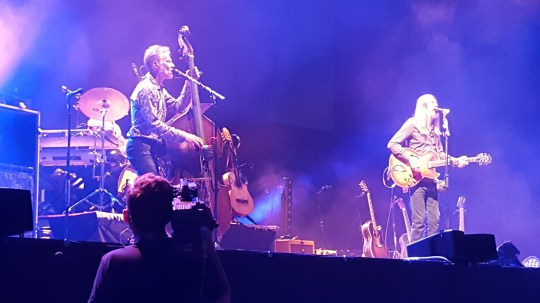
On Saturday, August 14, I had the pleasure of attending The Wood Brothers concert at the Bethlehem, PA festival Musikfest. Since live music is still just making it’s comeback in fits and starts, it’s a real joy to be able to go to a live show. And I have to say that this show was one of the best I’ve been to in a long time. The band was amazing. Their music spans genres from Americana to bluesy rock with a funky jazz feel. It’s a three person band with the majority of songs being played with electric guitar, stand up bass and drums. They would switch up to acoustic guitar, electric bass and the drummer playing an interesting hand percussion instrument tricked out guitar (the drummer, Jano Rix, would also sometimes play keyboard with one hand while still playing kit drum – a pretty nifty trick). The band puts on the type of show I really enjoy, loose flowing fun, nor overproduced. For me it had more of a 70’s concert feel. Throughout the show the band had people on their feet dancing along, a real connect with the audience. Chris Wood is jazz school trained and you could really see this in some of the lines he was playing on double bass – really amazing. Oliver Wood played some smoking slide guitar parts and had a perfect rough vocal for the type of music they do. They do wonderful harmonies on the songs. It was a well put together set with driving songs to build peaks then a ballad style song to change the pace.

I found an amazingly cool video that really gives a feel for the music The Wood Brothers play. In 2013 they released an album titled ‘The Muse’. In 2020 they recorded a full live version of the album. They recorded outdoors, a perfect backdrop for their music. This was not a live show with an audience, so they were able to make sonically crisp and clear versions of the songs. It’s a long video since it’s all the songs on the album, but you can, of course, browse through the video. It certainly gives a great representation of all the styles they play and is well worth a full view if you have the time.

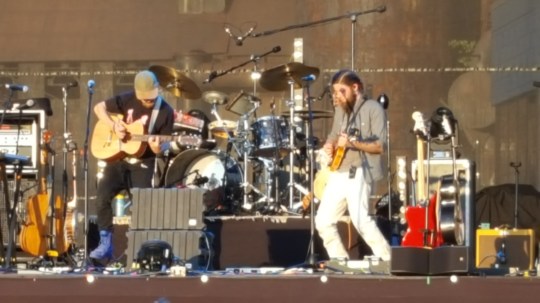
Before we went to the show I hadn’t checked to see who the opening bands were. I was pleasantly surprised to see that the opening band was Parsonfield. I reviewed one of their songs for a Grapevine post last year (see September 2020 Grapevine). They played this show as a two piece with some backing percussion tracks. It’s a challenge for a band to do a two person set on a live stage, but they pulled it off in fine style. They changed instruments several times moving between guitar, bass, banjo and mandolin. a very upbeat and energetic set. (Excuse the blur on the second image – I’m not great with phone photos).

Here’s a live clip of Parsonfield playing as a two piece.

I wanted to finish with saying what a wonderful venue the South Bethlehem stage at Musikfest is. The color lit backdrop of the old steel factory provides an amazing setting, the sound was top notch and the audience was really in to the show. Couldn’t ask for a better night.

Messin’ With The Music Part 16 – ‘Hash Pipe’

‘Hash Pipe’ was released in 2001 on Weezer’s third album titled ‘Weezer’ but usually referred to as ‘The Green Album’ (since they’ve used ‘Weezer’ as the title of several albums). I’ve always liked the straight forward, hit you on the head with a hammer nature of the main riff. When it came out I was also fascinated that it was a radio single considering the title and the nature of the lyrics. It’s interesting that when I went to the the official video to relearn the song the video now says ‘revised’ and they’ve totally cut out the lyric line in the song with the words ‘hash pipe’. Not bleeped out words – the musical line is totally removed! Ummmm- OK.

Part of the reason we do the cover songs is to work on the recording process and song arrangement so we can apply what we learn to our own songs. Song arrangement is a process people don’t usually consciously think about when they listen to music, but it’s a very important part of making any song have a distinct sound and feel. For instance in ‘Hash Pipe’ even though we used acoustic instruments and don’t have a drum kit to drive the beat, the acoustic version we did sounds a bit denser to me. That’s a result of using a variety of instruments playing more arpeggiated parts. So while the original may have more straight forward power drive, an acoustic version may sound softer but still a bit ‘thicker’. That’s all part of the learning process. This version has two six string acoustic guitars, a twelve string acoustic, banjo, bass, wood block, shaker and tambourine and several tracks of vocals. The lead riff is done with mandolin and a six string banjo.

Electrostatic Rhythm Pigs cover Weezer’s ‘Hash Pipe’: