There’s a lot of good things about having your own studio to record in. You can work on anything you want, anytime you want. You can take your time recording your own music and not have to worry about how much money you’re spending, giving you the ability to experiment. We’ve been having a lot of fun working on cover songs and have been able to create them at our own pace. We’ve also been able to create videos of us playing our own music live. Since the band consists of the two of us, playing in the studio gives us the ability to record some tracks ahead of time then play the other parts live along with the recording for the video. The song in this video, ‘Countdown’ was recorded for our EP ‘Celebrity Prostitution’ (it’s available to buy as a digital download on CD Baby and other places – you can check it out on the Velvet Wrinkle Wreckerds label website). Because the original recording was made in ChurchHouse Studio, we’re able to use parts of it for a live video rendition. The original EP version had multiple tracks of vocals and guitar. For this video we stripped all of that off and just kept the bass and drum tracks. So what you see in the video is literally what you would hear from us playing out live. There’s no overdubs or punch ins on the vocal and guitar tracks. Just turn on the video and let it rip. We did the video on a simple GoPro recorder which gives you that ‘fish eye’ wide view along the edges. We had a lot of fun recording this way.
Here’s Electrostatic Rhythm Pigs playing ‘Countdown’, live in ChurchHouse Studio:
When you have a musician coming in to the studio to work, you want them to have the best experience they can. Your job is to make the recording process as transparent or invisible as possible for them. This allows them to totally concentrate on their playing and creativity without having to worry about the technical aspects of the recording process. I recently had a friend come in to start working on a new song. Time is a precious commodity so we wanted to complete as many tracks as possible in one session. He wanted to see if we could complete the guitar, bass and vocal tracks in one session. We’ve worked together before and he’s an amazing musician, so I knew he’d hold up his end and have his track ideas ready to go. My job is to have the studio prepared to move seamlessly from one track to another. Here’s some basic preparation steps that will allow you to do that in the studio.
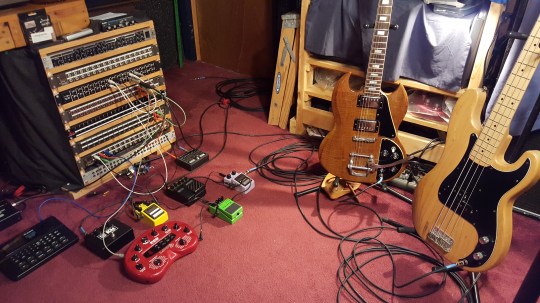
1) Decide what equipment you’re going to use. One of my goals is to give the musician multiple sonic options whenever possible. In this case that applies mostly to the guitar sound. If the musician has a particular amp or effect pedal of their own that they want to use, I try to get it in to the studio before they get there so I can have it miced and pathed. In this case we were using all in house studio equipment and decided to use stomp box FX pedals instead of rack mounted FX units. This photo shows the overall floor pedal setup.
2) Set up the effect path. The guitar signal is split at the stereo chorus pedal (the pink pedal). One line goes to a delay pedal, a flanger and a distortion pedal to an amplifier. The other line goes to a phase shift pedal and then in to a POD direct in amp emulator. This allows for a variety of guitar sounds to be recorded in one pass, both amped and direct in. The order of the pedals does make a difference in the overall sound. You can try several configurations to get what you want.
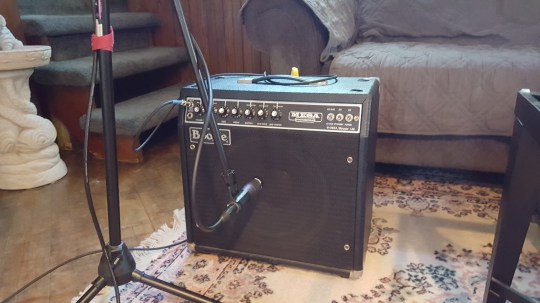
The output from the distortion pedal goes to an amplifier set up in another room. Although this large room is great for natural reverb, in this case the amp is just close miced with an SM57.
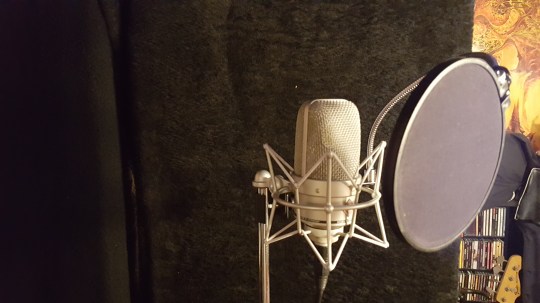
The bass guitar goes to a ten band EQ pedal. You can see it in the upper right picture of all the floor pedals. I love this pedal for bass, whether recording or live. It allows you to really dial in a specific EQ as well as boosting the signal if necessary. Two other items will go in to the patch bay. One is the drum machine seen in the upper left of the pedal picture to use for a click track. For vocals we have a Neumann mic going in to the patch bay.
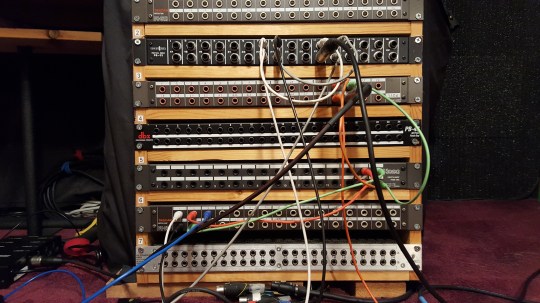
3) Set up the signal path through your patch bay. This is where you run your incoming signals in to the rack mounted units then in to your mixing boards. I have paper diagrams of all the patch bays connections – when you have a lot of connections you don’t want to make any mistakes.
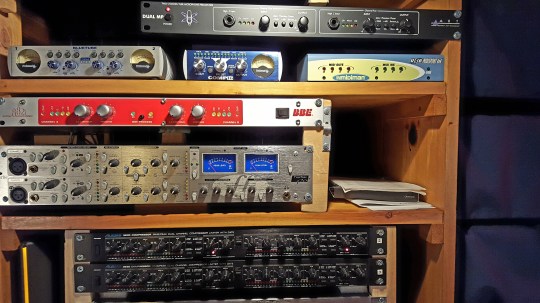
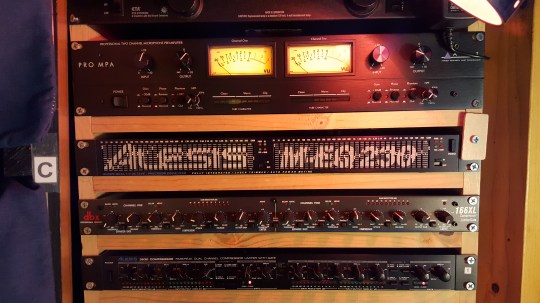
For this session all the inputs except the drum machine will run in to rack mount pre-amps and compressors/noise gates. Although the mixing boards have pre-amps and compression for each channel, I like using the higher quality outboard units. For me they’re also easier to fine tune.
4) Set up the signal path through the mixing boards. Decide what channels in the mixing board each signal is going to. I’d advise coming up with a logical system that works for you. I tend to set up multiple recording tracks by instrument the same way for most sessions. This makes my life a lot easier as ‘muscle memory’ will kick in if you’re trying to move quickly to make an adjustment during a recording take.
This is also where you select where each track will go in to your recording software. On a digital mixing board you should have a page that defines where the signal will be sent to. Again, try to maintain a consistent logic as you do this setup.
You can now set up the tracks in your recording software. You’ll want to keep the same order whenever possible. I usually have tracks that go left to right on the mixing board go top to bottom in the recording software.
5) OK, here’s where the organization part really needs to kick in. I like to create a chart for everything in the recording path. With this many transitions and connections, there’s a pretty good chance you could have some type of failure in one of the pathways during the session. The last thing you want to do is have to start guessing where a problem is while you’re trying to record. I don’t want to have the musicians standing around waiting while I’m trying to make a fix. It just feels less professional to me. And it could put a stall on the musician who was on a roll. Inspiration is like lightning in a bottle. When you catch it you want to keep it.
6) Test every pathway. I go one path at a time and test all the connections from the instrument all the way in to the recording software. I work to get a good strong signal level at each stop. Make sure the effects pedals work. Get a good strong signal in the pre-amps, compressors, mixing boards and software. Get basic settings ready in the pre-amps and compressors. That way when you’re recording the changes will be tweaks rather than ‘where the hells the signal?’. This is when you can change out a cable if it’s causing a problem.
All of this does take time. And nothing is perfect. You’ll probably hit some small glitch in any session you do. But when you get to run a smooth recording session it will all be worth it. In the session I was referencing in the beginning we completed the click track, four guitar tracks, the bass and three vocal tracks in a three hour period. And the session was a lot of fun. You can’t ask for much more than that. Now – go out there and create!
For Part 15 of our Messin’ With The Music’ series we decided to tackle ‘Lawyers’ Guns And Money’ by Warren Zevon. The song comes from Zevon’s 1978 album ‘Excitable Boy’. This was a huge album for Zevon and contained many of the songs people know from him – ‘Excitable Boy’, ‘Werewolves Of London’, ‘Roland The Headless Thompson Gunner’ as well as ‘Lawyers, Guns And Money’. There’s a lot of ways you can describe Zevon’s songwriting, but one part of his music that I always enjoy is the entertainment value of the lyrics. First, his vocal style makes the lyrics pretty easy to hear and understand. Many of the song lyrics are built as stories: some humor, some fun, some just out and out strange. He may be an acquired taste for some people, but you’ll absolutely recognize who it is when you hear them on the radio. Another cool thing about this album is the amazing amount of well known musicians who participated in the recording besides the ‘main band’: John McVie and Mick Fleetwood from Fleetwood Mac, Jackson Browne, Jeff Porcaro, Linda Ronstadt, J.D. Souther, Waddy Wachtel, Jennifer Warnes, Danny Kortchmar to name a few. Some of those names might not be as familiar, but if you look them up you’ll see how many well known songs and albums they’ve played on. Zevon was definitely a well respected musician among his peers.
For our version the main instrument holding down the song is a twelve string guitar. We recorded it twice and panned the tracks hard left and right. For these acoustic versions this is a common way we start the songs as it builds a good stereo field and makes the song sound full. If you had drums and electric guitars, they would usually handle that part of the recording. There is a six string guitar and a six string banjo. Besides the chords during the vocals, they play riffs in between the vocal parts, sort of mirroring the guitar that plays on the original song after the second verse. We also added mandolin and bass parts. There are duo vocals on this song – we actually sang both live in the same room at the same time. That was a lot of fun. We’d usually add some percussion, but with the banjo and guitar playing riffs, it seemed pretty full and more percussion wasn’t necessary.
Electrostatic Rhythm Pigs cover Warren Zevon’s ‘Lawyers, Guns and Money’:
We have another Electrostatic Rhythm Pigs ‘Live In The Studio’ performance for you. This time we recorded a live version of our song ‘The Wish’. This song was originally created with our previous band Conduit for the CD ‘Superior Olive’. You can find out more about the band and the CD version by visiting the website for our record label Velvet Wrinkle Wreckerds. The version in this video is performed with just vocals and acoustic guitar. That’s how we write most of our songs, so this gives you an idea of how we start out with a tune before we add all the other parts for the full studio version. This version is recorded with just two room microphones. We want our blog reading friends to have the feeling of sitting with us in the room as we play, so the video is live start to finish from turning on the camera to the end, comments, silly faces and all.
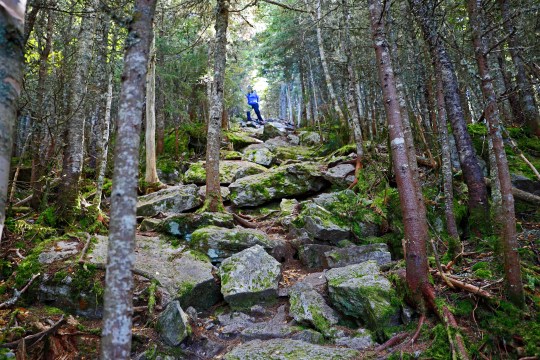
And….the story of the t-shirt. For anyone who’s not from the northeast US, ‘Live Free Or Die’ is the state motto of New Hampshire – it’s also on their license plates. New Hampshire is an awesomely beautiful state, so I wanted to give a ‘shout out’ in the video like when I wear national park t-shirts (please support and cherish your national parks). I always thought it was such a cool motto to have on a license plate. If you want great hiking, head to the White Mountain National Forest. Some wonderful, rock strewn trails to challenge you. I’ve included a photo from the last trip my wife and I took below .
Anyway, here’s the video – Electrostatic Rhythm Pigs performing ‘The Wish’ live in ChurchHouse Studio.
July has arrived with the summer heat melting everything in sight. Live music has begun to open up which means more bands will begin to get an opportunity to tour the music they have been recording. As I read through record reviews this month I really took note of some interesting trends that happened to recorded music over the past year. The pandemic was a huge topic of many songs that were written, in some cases it became the theme of whole albums. A lot of artists also had to change their recording styles, figuring out how to work together as a band while not being able to be in a studio at the same time. This was especially true of bands where all the musicians were not living in the same city. That had a big effect on the way their music sounded and resulted in new styles and experiments for the artists. Another trend was musicians in bands working on solo projects. Since the entire band could not be together to record, individuals put out songs that they had been working on or had demoed that did not fit in to the fabric of the band as a group. This made for some interesting new material being released. The advent of easy home recording has certainly aided this trend as you can get a decent recording on a low home budget. Studios will remain a higher level option due to the quality of mics, preamps, mixing boards, monitors, etc that are available (of course I’m a bit biased on this having a studio, but it really is true). Well, on to our selections.
First Up: Carter Tanton – ‘Steep Angles’
We’re going to start out with something simple, slow and moody. I do enjoy full band hard driving tracks, but there’s something about a simple guitar (or any single instrument) and vocal track that can really touch your soul. Here we have two guitars, vocals and harmonica. The guitars are blended well and if you don’t listen very carefully it sounds as if only one guitar is being played. When I break these songs down for review I always listen to them on headphones. When you do this you can pick out the two instruments as they are slightly panned to the left and right channels. Technically, the more you pan them the easier it is to hear the difference, but the object here was to have the guitars heard as a blended single entity. The vocals have a real nice tone and EQ. With spare instrumentation like this the layers of reverb pull all the instruments together. The harmonica maintains the melancholy tone of the song, adding a melodic line that mirrors yet is different from the vocals. You can hear early Neil Young influences in the sound, without it being an out and out identical copy. Beautiful mood music as it can match the mood you’re in or bring you to that sad, open prairie space.
Next Up: Riley Downing – ‘Good To See Ya’
Let’s move in to blues territory. Riley Downing offers a nice blend of traditional blues along with some New Orleans flavor on ‘Good To See Ya’. The song follows the basics of a traditional blues song as far as the chord progressions and tone. The guitar has just the right amount of distortion, adding some ‘dirt’ without being over fuzz toned. If you listen you’ll hear the occasional second guitar playing with a good bit of digital delay added to draw out the note and move you in to the next part of the song. It works as a nice transition. The vocals fit nicely in to the blues feel, low and simple with just the right amount of expression. What set this song apart from a lot of blues songs for me is the addition of accordion and New Orleans flavored organ sounds mixed in. This background does just enough to pull the song out of a totally standard blues feel. There’s some nice simple guitar and organ work during the break. The drums do a cool touch at the end of that brake where they’re layered with extra reverb as well as what sounds like hand claps added. When you’re playing blues, which really can be very standard, it’s the extra touches like this and the accordion background that can make the difference. Also note the back and forth pull between guitar and organ gives the song a nice unbalanced feel. A very well put together blues tune.
Finally: Reigning Sound – ‘I Don’t Need That Kind Of Lovin’
Let’s finish up with some straight ahead rock. Start the song with some great distorted guitar with a cool lead riff. Add in vocals and stir. The guitars and vocals are put out front in the mix. The drums and the bass are a bit in the background. There is a doubling harmony for the vocals in the chorus and handclaps added to the drums. After the second chorus there is break that has a short held chord slowdown with a change in the vocal tone. It revs back up with guitar lead before returning to the vocal. At 2:04, bang, the song is over. Short, sweet, hard hitting rock tune. Seems like a great song to hear live. This style goes back to the earliest rock songs when the tunes were short and to the point. Over time most songs got longer and a bit more complex. I think there’s still plenty of room for the great two minute rock blast. Good old rock n roll fun.
Retro: Rod Stewart – ‘Every Picture Tells A Story’
This song is from Rod Stewart’s third album of the same name. There’s so much I like about this song and it typifies many of the reasons I still get goosebumps listening to songs from this era. The biggest overall reason I love this style song is the loose feel of the arrangement and playing. It’s something I think is sorely missing from music of today – especially music that is more popular and ‘commercial’. Much of the musical backing is from The Faces, the band that Stewart had begun his career rise with. The song alternates between vocals and guitar riffs, both of which maintain that amazing loose blast. We also have some solos from a great blues bar room riff on piano. There’s sections where the instrumentation becomes more minimal and then fires back up again. The song is played like a journey which mirrors the fact that the lyrics really do tell a front to back story. It starts with a beautiful arpeggiated guitar part that is an intro to set up the rest of the song. The guitar has a great ring, a wonderful, unprocessed guitar sound before a held chord heralds the beginning of the vocals. All the parts from vocal, guitar, drums, piano and bass can be heard clearly. The stereo field placement adds to the ability to hear everything clearly with guitars panned hard left and right for full effect. There’s a slow down break at around the 3:30 mark of the song. Props to back up vocalist Maggie Bell for the added vocals in this section and the end of the song where her vocals are given as much heft as Stewart’s. The song ends with a minute plus long run out. The song arrangement is so well done you don’t realize it’s a six minute long song. I never get tired of hearing this song. Classic.




 ChurchHouse Productions Blog